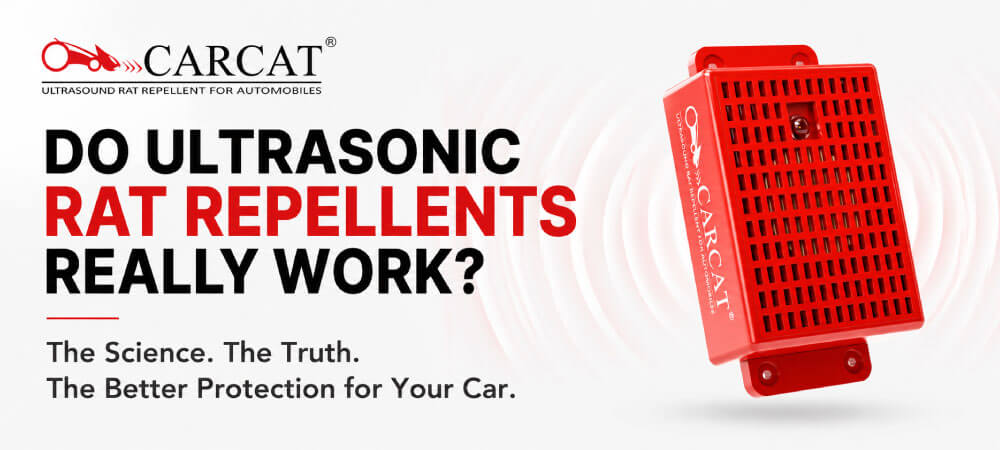
Do Ultrasonic Rat Repellents Really Work? The truth about ultrasound rat repellent for cars
If you have searched online for ways to protect your car from rats, you have probably come across a familiar claim: “Ultrasonic rat repellents don’t work.”
But there is an important question that these articles often fail to address:
Are all ultrasonic rat repellents actually the same?
The answer is no.
There is a significant difference between a basic device that continuously produces ultrasound at one frequency and a purpose-built rodent-repellent system engineered around rodent behaviour, acoustic patterns, frequency variation and the environment in which it is installed.
This distinction matters—especially when the target is your car.
Why Do Rats Enter Car Engine Bays?
A parked car can provide exactly what a rat is looking for: shelter, warmth, darkness and protection from predators.
The engine compartment also contains materials that rodents may chew, including wiring insulation, plastic components, hoses and other soft materials.
Once a rat establishes a habit of visiting a vehicle, the problem can become expensive. A damaged wire harness or electrical component can turn what looks like a small rodent problem into a substantial repair bill.
That is why prevention is generally better than waiting until damage has already occurred.
So, Does Ultrasonic Rat Repellent Work?
The honest answer is: the technology is real, but the performance depends heavily on how the device is engineered and used.
Scientific research has demonstrated that rodents can respond behaviourally to ultrasonic and high-frequency sound. Controlled experiments have specifically investigated ultrasonic devices as rodent repellents. (eScholarship)
However, research has also shown an important limitation: rodents can become accustomed to repetitive or unsuitable sound patterns.
One published study found that a particular ultrasonic stimulus initially reduced rat feeding activity, but the effect diminished after about a week—an example of behavioural habituation. (ScienceDirect)
This is one reason simply saying “ultrasound doesn’t work” is an oversimplification.
A more accurate question is: What kind of ultrasound is being generated, how is it being delivered, and is the device designed to minimise habituation?
The Problem With Basic Ultrasonic Devices
Many inexpensive ultrasonic products are essentially simple sound generators.
They may operate around a particular frequency or use a relatively repetitive signal.
The problem is straightforward: if an animal encounters the same stimulus repeatedly without an actual threat, it may eventually learn that the stimulus is not dangerous.
This phenomenon is known as habituation.
It is one of the reasons some consumers report: “It worked initially, but the rats came back.”
That experience should not automatically be interpreted as proof that ultrasound itself is ineffective.
It may instead demonstrate the limitations of a particular device or signal design.
The Difference Is in the Engineering
Effective rodent deterrence isn’t simply about producing a sound that humans cannot hear. The important factors include:
- Frequency range
- Frequency variation
- Sound pattern
- Intermittent or changing signals
- Acoustic output
- Installation position
- Reflection of sound within the protected area
- The behaviour of the target rodent
- Continuous operation
- The environment in which the device is being used
This is where purpose-built automotive ultrasonic systems are fundamentally different from generic plug-in pest repellents.
How CARCAT RED Uses Ultrasonic Technology
CARCAT RED is designed specifically for protecting automobile engine bays from rats and rodents.
Rather than relying on a basic single-frequency output, CARCAT RED uses a ZigZag ultrasound algorithm with intermittent pulsing. The system is designed to create a changing and less predictable auditory environment for rodents. (CARCAT RED)
CARCAT also combines ultrasound with green/blue LED strobing, targeting both auditory and visual senses of rodents.
The objective is not to kill the animal. The objective is to make the engine-bay environment less favourable for the rodent.
This is an important distinction between a repellent and a poison or trap.
Why Changing Sound Patterns Matter
Imagine hearing exactly the same noise every few seconds for weeks. Initially, it may be irritating. Eventually, your brain learns that the noise represents no immediate danger.
Rodents are also capable of behavioural adaptation. That is why simply increasing the volume of a repetitive signal isn’t necessarily the answer.
A better engineering approach is to create a more dynamic stimulus.
CARCAT’s technology uses frequency-pattern algorithms rather than depending solely on a single fixed ultrasonic tone. CARCAT states that its technology is based on a broadband piezoelectric crystal and changing frequency patterns. (Science & Technology)
The goal is to make the environment continuously uncomfortable and unpredictable for rodents.
Why a Car Is a Different Environment
Another important point often missed in generic “ultrasonic doesn’t work” articles is where the device is being used.
A house, warehouse, open garden and car engine bay are completely different environments.
Ultrasound behaves according to the physical environment in which it is generated. An enclosed engine bay contains multiple surfaces that can reflect sound. Installation position therefore matters.
CARCAT RED is specifically designed for an automobile’s engine-bay environment rather than being a generic household pest-control device. (CARCAT RED) That purpose-built approach is important.
CARCAT Doesn’t Claim That Rats Will Never Enter Your Car
This is another misconception worth addressing.
A rat may occasionally enter an engine bay for reasons unrelated to establishing a permanent nest—for example, while escaping a predator or seeking temporary shelter.
The objective of a repellent is to make the environment unsuitable enough that the rodent does not comfortably stay and establish itself.
CARCAT itself recommends a proactive approach and acknowledges that occasional signs such as paw marks or droppings may still occur.
That is a much more realistic expectation than claiming that a device creates an invisible “rat-proof force field.”
What About Rat Repellent Sprays?
Rat-repellent sprays work through a completely different mechanism. They rely primarily on olfactory deterrence—creating a smell that rodents find unpleasant.
The major limitation is persistence. A spray is a chemical layer applied to a surface. Its effectiveness can change as the chemical evaporates, gets washed away, becomes contaminated with dust or simply loses its intensity.
That means maintaining protection can require repeated application.
An electronic repellent, on the other hand, can operate continuously as long as it has power.
For a parked car, that distinction is important.
Spray vs. Ultrasonic Protection
| Factor | Rat Repellent Spray | Purpose-Built Ultrasonic Device |
|---|---|---|
| Primary mechanism | Smell / olfactory deterrence | Acoustic deterrence |
| Requires repeated application | Usually | No |
| Continuous operation | No | Yes, when powered |
| Chemical application | Yes | No |
| Can operate while car is parked | Only while residual effect remains | Yes |
| Maintenance | Periodic reapplication | Minimal |
| Designed specifically for engine bay | Depends on product | CARCAT RED is |
| Kills rats | No | No |
The comparison does not mean every ultrasonic product is automatically superior to every spray.
It means that for continuous, non-chemical prevention in a parked vehicle, an electronic repellent offers a fundamentally different—and potentially more practical—approach.
What About Poison and Rat Cakes?
Poison creates another problem. The rat has to consume the bait. If it does not, nothing happens.
And if the rat does consume it and dies somewhere inside or around the vehicle, the resulting problem can become unpleasant and difficult to locate.
For a car owner, the preferred strategy is therefore often prevention rather than waiting for the rodent to consume something after entering the vehicle.
CARCAT’s approach is to discourage the rodent from treating the engine bay as a comfortable environment in the first place.
The Better Question to Ask Before Buying
Instead of asking: “Does ultrasonic rat repellent work?” ask:
- 1. Is the product specifically designed for rats and rodents?
A device designed specifically for automotive rodent protection is preferable to a generic household gadget when your target is a car. - 2. Does it use a changing signal?
Frequency and pattern variation can be important when dealing with behavioural habituation. - 3. Is it designed for continuous operation?
A car can remain parked for hours or days. Protection therefore needs to work when the owner isn’t around. - 4. Is it suitable for the engine-bay environment?
Heat, moisture, vibration and electrical conditions matter. - 5. Does the manufacturer provide technical information?
Look for actual specifications, operating principles, installation instructions and testing information—not just marketing slogans. - 6. Has the product been tested for automotive use?
Automotive-specific testing is more relevant than generic claims about household pest control.
Why CARCAT RED Is Different
CARCAT RED is built specifically around the problem of rats entering automobile engine bays.
Its current-generation system combines: ZigZag ultrasound + intermittent pulsing + green/blue LED strobing + automotive-grade construction + continuous protection.
It is also designed with features such as battery-voltage monitoring, standby operation and low-power consumption for automotive use. (CARCAT RED)
CARCAT states that the product has been tested by the Automotive Research Association of India (ARAI) and conforms to relevant CE requirements listed by the manufacturer.
The Bottom Line
The statement “ultrasonic rat repellents don’t work” is too broad.
The real issue isn’t simply ultrasound vs. no ultrasound. It is poorly engineered ultrasonic products vs. properly engineered rodent-repellent systems.
For protecting a car, prevention is particularly important because rodent damage can occur before the owner even realises a rat has entered the engine bay.
A purpose-built system such as CARCAT RED takes a different approach: instead of waiting for a rat to eat poison, fall into a trap or become exposed to a spray, it continuously makes the engine-bay environment less favourable to rodents using an engineered combination of ultrasonic and visual deterrence. (CARCAT RED)
Don’t ask whether “ultrasound works.” Ask whether the ultrasonic device you’re buying is actually engineered to work against rodent behaviour.
And when the goal is protecting your car, choosing a purpose-built automotive rodent-repellent system is a far more meaningful decision than choosing a generic gadget simply because it produces an ultrasonic sound.
CARCAT RED — engineered to keep rats away from your car.
Additional Resources
- Installation Guide for your CARCAT device.
- Request an Installation Service.
- Complete your Warranty Registration today.
- Have questions? Check our FAQs or our Troubleshooting Guide.